Skip to content

HomeAI Pit Crew

PitWorX

AI Pit Crew

Meet the AI Pit Crew.The maintenance team that never clocks out.

The AI Pit Crew reviews every vehicle fault, explains what is wrong in plain language, rates how urgent it is, opens the service request, and queues the repair task. Your team starts the day with decisions to approve, not faults to chase.

PitWorX AI Pit Crew

Sample view

In the app

A diagnosis your team can read, check, and act on.

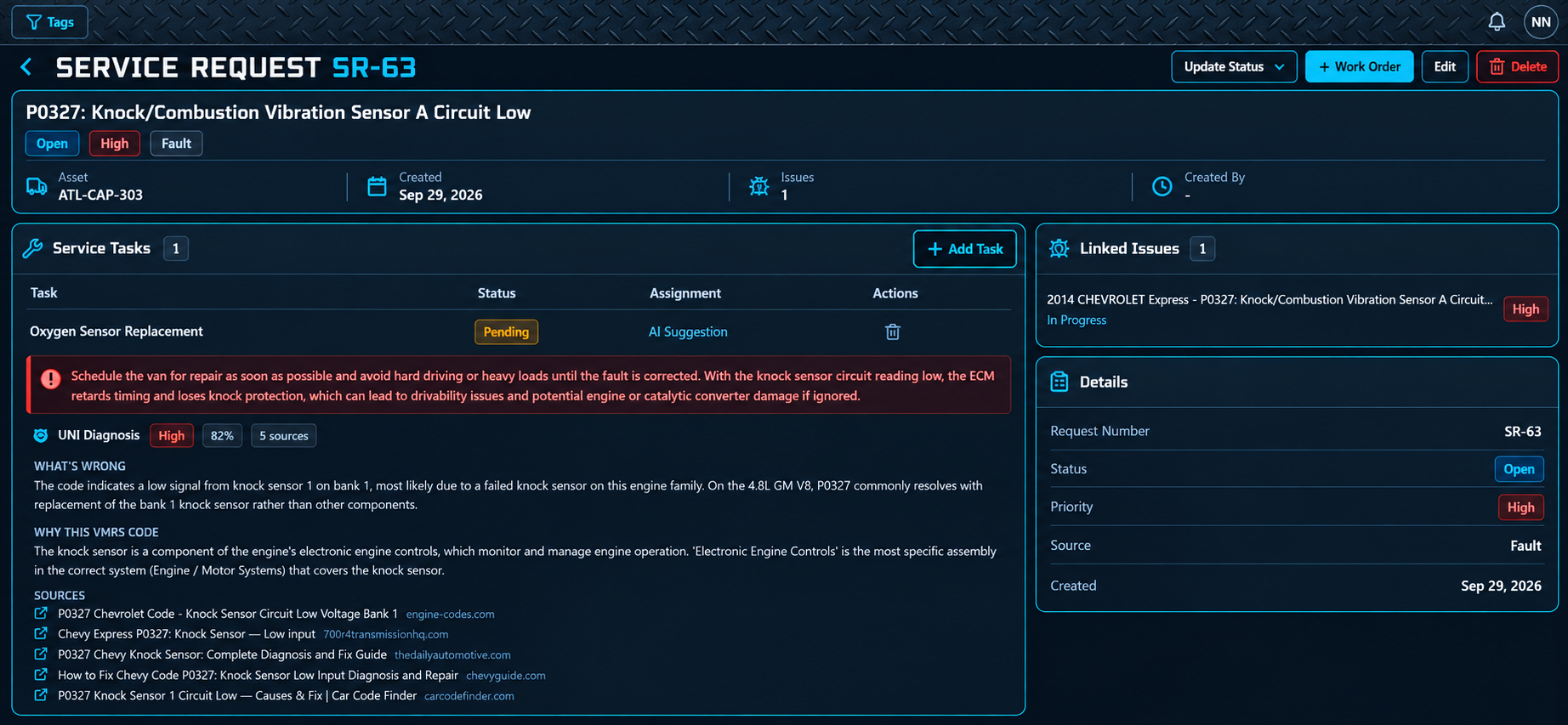
This is a real service request opened by the AI Pit Crew. The diagnosis, the urgency, the sources, and the repair task are all on the record before anyone has picked it up.

PitWorX Service request

A PitWorX service request opened by the AI Pit Crew for a knock sensor fault, showing the recommended action, a plain-language diagnosis, the reason for the repair code, and cited sources

Swipe to explore

A service request opened by the AI Pit Crew.
  1. 01

    What is wrong

    The most likely failing part, explained in plain language, for the specific vehicle that reported the fault.

  2. 02

    Urgency and recommended action

    A clear rating and a plain instruction, such as whether the truck can stay on the road or should be repaired as soon as possible.

  3. 03

    Confidence

    A confidence score shows how well supported the diagnosis is, so your team knows how much weight to give it.

  4. 04

    Cited sources

    The references behind the diagnosis are listed on the record, so anyone can check the reasoning.

  5. 05

    Repair task, ready for your team

    The repair task is added to the service request with an industry-standard VMRS code, ready to assign and dispatch.

How it works

From a fault code to a queued repair, in five steps.

  1. Step 1

    Detect

    A vehicle reports a diagnostic fault. The AI Pit Crew picks it up as soon as it arrives, based on the automation rules you set.

  2. Step 2

    Diagnose

    It identifies the most likely failing part for that exact make, model, and engine, then explains the problem in plain language.

  3. Step 3

    Prioritize

    It rates urgency, states how confident it is, and recommends what to do with the vehicle in the meantime.

  4. Step 4

    Request

    A service request opens on the asset with the diagnosis, the sources, and the priority already attached.

  5. Step 5

    Queue the task

    The repair task is added with the correct VMRS code, ready for your team to assign, dispatch, and approve.

The difference

Less time spent finding and writing up faults. More time fixing them.

Without the AI Pit Crew

  • A fault code appears and waits for someone to notice it
  • Someone looks up what the code means
  • Someone researches the likely cause for that engine
  • Someone writes up the service request
  • Someone finds the right repair code
  • Someone creates the task and sets the priority

With the AI Pit Crew

  • The fault is picked up the moment it is reported
  • The likely cause is identified for that exact vehicle
  • Urgency and a recommended action are set
  • The service request is opened with everything attached
  • The repair task is queued with the right code
  • Your team reviews, assigns, and dispatches

Benefits

A smarter maintenance process, end to end.

Faster response

Faults move from the vehicle to a queued repair without waiting for a person to notice, research, and write them up.

Less manual triage

Dispatchers and managers stop decoding fault codes and retyping details, and spend their time on decisions.

Smarter prioritization

Urgency ratings and plain-language guidance put the faults that threaten safety or availability at the top of the queue.

Consistent repair coding

Tasks are matched to industry-standard VMRS codes, so history, cost reporting, and analytics stay consistent across the fleet.

Transparent reasoning

Every diagnosis carries its confidence and its sources, so nothing is a black box.

Earlier action

Acting on a fault while the vehicle is still running helps your team avoid a breakdown instead of responding to one.

You stay in control

AI that works for your team, not around it.

The AI Pit Crew handles the research and the paperwork. People keep every decision that matters.

Review before work begins

When confidence is low, the task is flagged for review, so a person confirms the diagnosis and repair code first.

Your team makes the calls

Your team assigns the work, approves quotes and invoices, and signs off on completed service.

You choose what it picks up

Automation rules you control decide which faults the AI Pit Crew works on, so you can start with the ones that matter most.

Questions

About the AI Pit Crew.

What is the AI Pit Crew?

The AI Pit Crew is the AI agent inside PitWorX. It reviews vehicle faults, identifies the most likely failing part for that specific vehicle, explains the problem in plain language, rates the urgency, opens the service request, and queues the repair task for your team.

Does the AI Pit Crew replace my technicians or managers?

No. It does the triage and the paperwork so your people can focus on decisions and repairs. Your team still assigns work, approves quotes and invoices, and signs off on completed service.

How do I know I can trust an AI diagnosis?

Every diagnosis shows its confidence and the sources behind it. When confidence is low, the task is flagged for review before work begins, so a person always confirms the diagnosis and repair code first.

Which faults does the AI Pit Crew handle?

It works on diagnostic trouble codes reported by the vehicles in your fleet. Automation rules you control decide which faults it picks up, so you can start with the faults that matter most.

Put the AI Pit Crew to work on your fleet.

See your own faults diagnosed, prioritized, and queued for repair in a walkthrough with the PitWorX team.